
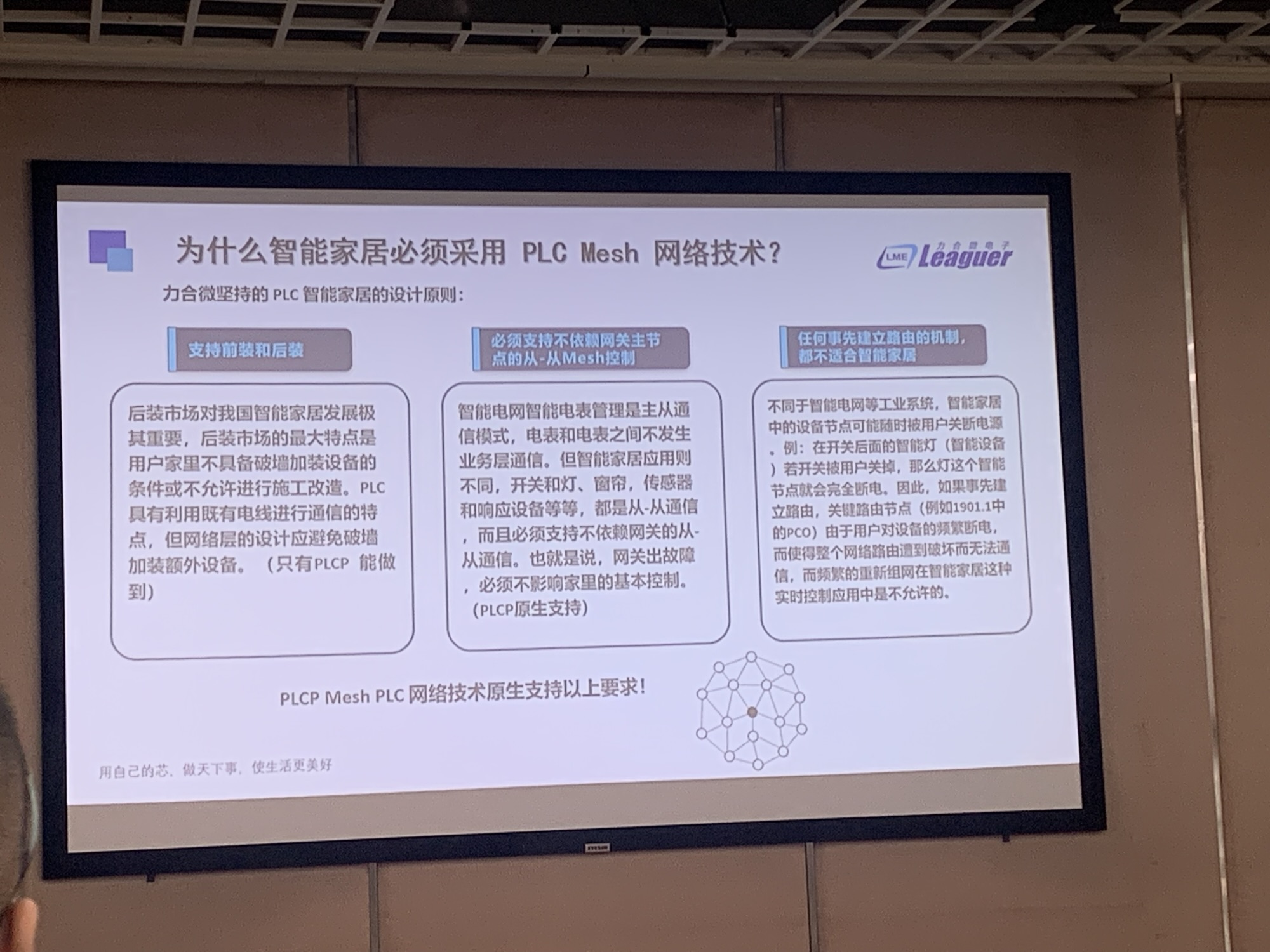
Technical design principles behind Leaguer’s PLC-based smart home architecture.
Principle 1: Native Support for Both Pre-construction and Retrofit Deployment
The retrofit market represents a critical growth vector for smart home adoption in China. Its defining constraint is that existing residential premises lack the structural provisions for in-wall equipment installation, and occupants typically will not tolerate invasive renovation work.
PLC technology leverages the existing power line infrastructure as a physical transmission medium. Crucially, however, the network layer architecture must be designed to operate without requiring additional hardware to be installed behind walls.
This capability is unique to PLCP.
Principle 2: Decentralized Slave-to-Slave Mesh Operation — No Gateway Dependency
Conventional smart grid architectures employ a master-slave communication paradigm, in which field devices (e.g., smart meters) exchange data exclusively with a central controller and never peer with one another at the application layer.
Smart home environments operate under fundamentally different constraints. Switches, luminaires, motorized curtains, sensors, and actuators must all communicate directly in a peer-to-peer fashion, independent of any central gateway.
The operative requirement: a gateway failure must never compromise basic device control within the home.
PLCP provides native support for this topology.
Principle 3: Pre-computed Routing Is Fundamentally Incompatible with Smart Home Dynamics
Unlike industrial systems and smart grids — where nodes are continuously powered and network topology is stable — smart home deployments face an inherent challenge: end-users can and do cut power to individual device nodes at any time.
Illustrative scenario: A smart luminaire installed downstream of a wall switch. When the user toggles the switch off, that node loses power completely. If the network relies on pre-computed routing tables, the removal of a critical routing node (such as the PCO specified in IEEE 1901.1) can fracture the entire network topology, rendering communication paths unavailable.
Frequent re-networking events induced by such intermittent power states are unacceptable for real-time control applications in the smart home context.
Conclusion
PLCP Mesh PLC networking technology natively satisfies all three architectural requirements outlined above.
Leave a Reply