
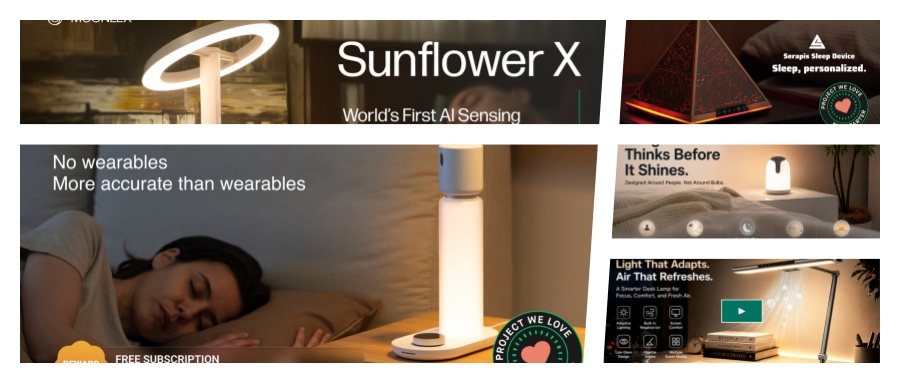
💡 Ever wondered what happens when you cross the most traditional hardware category with AI, sensors, and a dose of startup creativity?
I recently dived into Kickstarter to find out—not as a shopper, but as a product manager who’s spent 15 years in the lighting industry. What I discovered surprised even me.
Just in the “sleep + smart lighting” niche alone, there are over a dozen products with wildly different approaches. Each one is answering the same question: when illumination is no longer a scarce resource, what else can a lamp do?
Below is a breakdown of five standout products using a three-part framework: Use Case → User Value → Key Features. I’ll wrap up with my overall takeaways at the end.
1. Sleepal AI Lamp — Bringing the Sleep Lab to Your Nightstand

In a word: The world’s first non-contact bedside AI sleep system, using mmWave radar + multi-sensor fusion to create a bedside lamp that actually improves your sleep.
Use cases: Pre-sleep relaxation, in-sleep monitoring with environment sync, night-time motion-activated lighting, and gentle wake-up during light sleep cycles.
User value: The biggest value is effortlessness—no wristband, no electrodes, no setup. Just lie down and it starts working. And it doesn’t just give you a sleep score: it correlates snoring with sleep position, analyzes environmental factors, and delivers actionable advice from an AI coach. These are features that genuinely help you sleep better.
Key features:
- Six-sensor fusion: mmWave radar + sound + thermal + ambient light + temperature & humidity
- Clinical-grade AI: Trained on hospital PSG data, with respiratory rate accuracy on par with medical devices
- Privacy-first: Pure physical sensing, on-device processing, your data is never used to train models
- Freemium model: Basic features free; AI sleep staging and coaching via subscription
2. Sunflower X — The Sunflower-Shaped AI Sunrise Alarm Lamp

In a word: A 60GHz mmWave radar + auto-rotating light ring that takes “natural wake-up” to the extreme.
Use cases: Gentle wake-up during light sleep windows, gradual dimming for falling asleep, motion-activated night light, and everyday reading/ambient lighting.
User value: It solves a very specific pain point: the misery of waking up. Traditional alarms jolt you awake—this one waits until your body is ready. Using progressive light and sound stimulation, you wake up with significantly less grogginess.
Key features:
- Auto-rotating light ring: Sunflower design—light spreads from a point to full coverage like a sunrise, instantly recognizable
- 60GHz radar: 7 scans per second, 240,000+ data points per night, detecting chest wall displacement down to 0.1mm
- SureWake dual-layer wake-up: Light first, then sound—gradually intensifying to ensure you wake up without being startled
- AI sleep coach: Doesn’t just give you data—it explains why and offers lifestyle recommendations
3. Serapis — 5-in-1 All-Scenario Sleep Aid Device

In a word:: Schumann resonance + white noise + breathing light + fractal visuals + pyramid acoustics—all in one app-free, minimalist device.
Use cases: Racing-thought insomnia (fractal visual guidance), environment-sensitive insomnia (white noise masking), and jet lag/schedule disruption (light-sound rhythm sync).
User value: The biggest value is simplicity—no app, no account, no Bluetooth pairing. Unbox it, put it on your nightstand, press a button, and you’re done. With five sensory inputs working simultaneously, it has a higher success rate for people who’ve “tried everything and nothing works.”
Key features:
- Five-mode synergy: Schumann waves + layered white noise + breathing light + fractal visuals + pyramid acoustics
- Sleep type assessment first: Helps you identify “what kind of insomnia you have” before recommending a mode—educating users while improving conversion
- Zero digital friction: No app, no subscription, no data upload
- Strong scientific narrative: Every feature is backed by a framework of scientific discourse, making users feel “this isn’t pseudoscience”
4. Elunvia — The Smart Lamp That “Looks Away From Your Eyes”

In a word:: A 24GHz radar tracks your position and automatically redirects light to the wall behind you for 100% glare-free illumination.
Use cases: Glare prevention for screen workers, reflection-free night reading, motion-activated night light for couples sharing a bedroom, zero-blue-light gradual dimming before bed, and sunrise simulation in the morning.
User value: It solves a problem you might not realize you have but is always there—most lamps shine directly at you, and glare + reflected light are quietly wearing down your eyes. Elunvia’s logic is counterintuitive: a good lamp shouldn’t let you see the light source.
Key features:
- Radar tracking + auto-rotation: Detects where you are, swivels the lamp head away, and bounces light off the wall. The tech isn’t hard—the product insight is spot-on
- Truly zero-blue-light LED: Not “low blue light” and not a filter—blue light is eliminated at the chip level
- 7 scenarios in one: Bedside / reading / desk / whole-room / night light / wake-up / ambient
- Four control methods: Touch / App / NFC / timer—an entry point for every user preference
5. LUMORA — The Desk Lamp That Brings “Forest Air” to Your Workspace

In a word:: Dual-layer optical system + negative ion air system, creating a “forest-like” desktop light environment.
Use cases: Long hours of work or study, screen-based work, focused reading, pre-sleep relaxation, and when indoor air quality is poor.
User value: It’s not selling “a brighter lamp”—it’s selling a more comfortable desktop environment. By combining light and air, and packaging it as “forest feeling,” it delivers both functional benefits and emotional resonance.
Key features:
- Dual-layer optics: Forward task light + rear ambient light, reducing contrast between bright and dark
- Integrated negative ion system: Low cost, but elevates the product positioning from “desk lamp” to “desktop environment system”
- EML circadian lighting: Automatically adjusts the melatonin-affecting spectrum throughout the day
- Four modes for four scenarios: Reading & Focus / Screen Comfort / Relax & Sleep / Daily Rhythm
Three Observations From a Product Manager
After breaking down these five products, three strong impressions stand out:
First, the “lamp” category is being redefined.
Metrics that used to be the core—luminous efficacy, color rendering index, lifespan—are becoming table stakes. The new competitive dimension is: can this lamp sense me, understand me, adapt to me, and help me become better?
Second, both “less is more” and “more is everything” strategies are valid.
Banala and Serapis go minimalist—no app, no data, one-button operation. Sleepal and Sunflower X go all-in—radar + AI + IoT + subscription, maxed-out features. Neither is right or wrong—the key is which type of user you’re targeting.
Third, great products all have a one-liner memory hook.
Sunflower X is “the rotating sunflower lamp.” Elunvia is “the lamp that looks away from your eyes. If your product takes three sentences to explain, users probably won’t remember it.
Anyone in product knows: the hardest part isn’t adding features—it’s finding that one reason why people must choose you.
🤔 Your turn: Which of these five approaches resonates most with you? Are you a “minimalist, one-button” person, or do you prefer the full-stack sensor + AI experience?
I’d love to hear your thoughts—drop a comment below.
#SmartLighting #ProductManagement #SleepTech #IoT #HardwareStartups #ConsumerElectronics #AI #Innovation #ProductDesign
Leave a Reply